 Photo: Freddy Schinkel
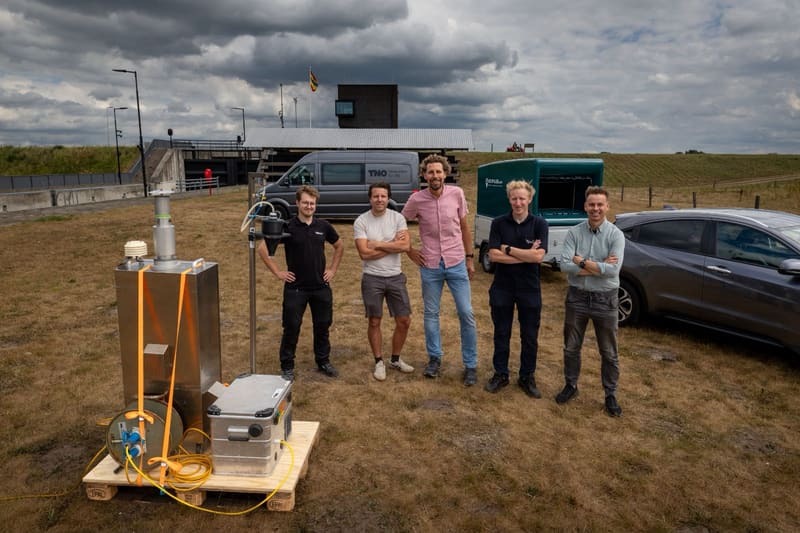
Can you map which plant and animal species live in a nature area without hundreds of hours of fieldwork? That is what Witteveen+Bos, EcoPulse, TNO and Datura are testing this summer in the Reevediep, a new waterway near Kampen, between the IJssel river and Lake Drontermeer. Using environmental DNA, eDNA for short, researchers collect and analyse traces of DNA. This builds a picture of the plant and animal species that occur in an area. This is already often done with water and soil samples, but what makes this pilot extra special is the use of air sampling.
Faster, broader and less disruptive
Traditionally, ecologists map biodiversity by surveying plants and animals in the field. That takes a lot of time, is labour-intensive and can disturb nature. With eDNA, part of that survey work can be done faster, more completely and with less disturbance.
eDNA does not replace traditional fieldwork, but is a valuable addition to it. The eDNA method can help to detect species faster and to target research more precisely. The method is becoming increasingly advanced and affordable, and therefore more widely applicable. As a pilot and as an investment in shared knowledge development, Witteveen+Bos, EcoPulse, TNO and Datura are sampling and analysing the biodiversity around the Reevediep. This is a new waterway near Kampen that was built under the Room for the River programme.
Reevediep
The Reevediep is a suitable place to test the eDNA method. The area was recently developed on behalf of Rijkswaterstaat and the Province of Overijssel. The former polder has grown into a wetland that is still developing. Birdwatchers from all over the country already come to admire species such as red-crested pochard, ruff, Caspian tern, Eurasian bittern and white-tailed eagle.
Sebastiaan Schep of Witteveen+Bos is the initiator of this pilot: ‘To achieve the necessary improvement in biodiversity, we need to make biodiversity as a whole more measurable. When I heard about the latest developments in measuring airborne eDNA, I wanted to test them at practical scale as soon as possible. The Reevediep, on which we at Witteveen+Bos advised, is ideally suited for this.’
The Province of Overijssel is also very interested in the results. ‘We worked on the project for years and witnessed up close the metamorphosis from a polder and meadow-bird area into a wetland’, says Arjan Otten, strategic nature advisor at the Province of Overijssel. ‘We have always monitored the development of plants, animals and habitats. But we have never properly mapped how biodiversity as a whole has changed.’
Sebastiaan Schep: ‘We compare the Reevediep with a polder that resembles what the area used to look like. We do this by comparing the eDNA survey in both areas. For this, we sample the air in the surroundings. EcoPulse deploys its mobile system on a number of predefined routes, sampling thousands of cubic metres of air over a large area in a short time. TNO is placing two fixed measuring points at the Scheeresluis lock, which record changes over time at a single location. The two methods are therefore complementary. Water and soil samples are also being collected. The captured eDNA is analysed in Datura’s lab.’
How does eDNA work?
Every living creature continuously leaves microscopic traces of DNA behind. Think of skin cells, hair, droppings, saliva, mucus or pollen. By analysing these traces from air, water and soil, it is possible to determine which species occur in an area. It will be interesting, for example, to see whether DNA traces of the Eurasian water shrew or the European weatherfish are found. Dedicated habitats have been created for both species in the Reevediep.
More monitoring needed
The eDNA method is promising when it comes to monitoring and improving biodiversity in the Netherlands. ‘We see that the demand for nature monitoring is increasing sharply. Not so much in nature reserves, but mainly outside them, such as in agricultural and urban areas. We will therefore continue to follow developments in eDNA research with great interest’, says Arjan Otten. ‘But, of course, I am also hoping for new species in the Reevediep that we don’t know about yet!’
Quotes translated from the Dutch press release.